

GRAVITION
Science
Class 11 | Class 10 | Maharastra Board

Points To
Remember :
· Gravitational Force is an universal force which is acting not only on any two bodies on the surface of the Earth but also on any two celestial objects.
· Gravitational force is an attractive
force.
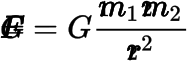
· Every object in the universe attracts every other object with a force, which is directly proportional to the product of their masses and inversely proportional to the square of the distance between their centres :
 · If two objects are spherical, the
force between them is along the straight line joining their centres and the
segment joining their centres is considered the distance between them.
· If two objects are spherical, the
force between them is along the straight line joining their centres and the
segment joining their centres is considered the distance between them.· Out of the two objects, if mass of one of the objects is doubled, then according to law, the gravitational force between the two objects gets doubled. If the distance between the two objects is doubled, the gravitational force between them becomes one fourth.
· Value of G is 6.67 × 10⁻¹¹ Nm2/kg2
· The centripetal force between the Sun and the planet Earth is responsible for the revolution of the Earth. It is inversely proportional to the square of the distance between them.
· The force that the Earth exerts on any object at or around the surface of the Earth is called the Earth’s gravitational force. According to Newton’s second law, the acceleration is produced in the body due to applied force.
· The acceleration produced by the Earth’s gravitational force is called acceleration due to gravity or gravitational acceleration. It is denoted by g = GM/r2
· The acceleration due to gravity depends on mass of the Earth (M) and radius of the Earth (R) for an object on the surface or height (h) at which the object is placed from the surface of the Earth. It does not depend upon the mass of the falling object. Thus, acceleration due to gravity is same for all freely falling objects.
· The unit of ‘g’ in SI system is m/s2. The mass of Earth is 6 × 1024 kg and its radius is 6.4 × 10⁶ m.
· The Earth does not have perfectly spherical shape. It is slightly flattened at the poles and bulged at the equator.
· Therefore, the radius of the Earth at the poles is less than that at the equator.
· The value of ‘g’ is maximum at poles and it is 9.83 m/s2 or 983 cm/s2.
· The value of ‘g’ is minimum at the equator and it is 9.78 m/s2 or 978 cm/s2 .
· As altitude increases, value of g
decreases.
· As depth increases, value of g decreases.
· The gravitational acceleration is considered 9.77 m/s2 for all the practical purposes.
· The acceleration on the Moon is 1/6Th of that on the surface of the Earth.
· When a body falls towards the Earth under the influence of the Earth’s gravity alone, its motion is called ‘free fall’.
· In ‘free fall’, body comes to the surface of the Earth with uniform acceleration. Initial velocity may be zero but it increases at every time interval, due to acceleration due to gravity.
· The mass of an object is the quantity of matter contained in it. The SI unit of mass is (kg) and CGS unit is gram (g).
· From Newton’s first law, we know that mass is the measure of inertia of a body.
· Mass is a scalar quantity and it does not change from place to place on the surface of the Earth and even it does not change on the different planets.
· The weight of the body is defined as the force with which the Earth attracts it towards its centre w = mg.
· Since the weight is a ‘force’, its SI unit is newton and CGS unit is dyne. (1N = 105 dyne)
· Weight is a vector quantity. It changes from place to place on the surface of the Earth and even changes with the planet.
· Since the value of ‘g’ is not same everywhere, the weight of a body keeps on changing with place.
· The weight of an object on the Moon is 1/6TH of that on the Earth. We can write it as, wm = m × gm.
· Spring balance is used for measuring weight and two scale balance is used to compare masses.
· Johannes Kepler (1571 – 1630) was a German astronomer and a Mathematician.
· Kepler’s first law: The orbit of a planet is an ellipse with the sun at one of the foci.
· Kepler’s second law: The line joining the planet and the sun sweeps equal areas in equal intervals of time.
· Kepler’s third law: The square of time period of revolution around the sun is directly proportional to the cube of the mean distance of a planet from the Sun.
· A body can have energy because of its shape or position or configuration. This is known as potential energy.
· The gravitational potential energy at the height (h) from the ground is -GMm/R+H
· Escape velocity is that initial velocity of an object by which it overcomes the Earth’s gravitational attraction.
· Escape velocity (vesc) can be calculated by the law of conservation of energy and is equal to vesc = √2gR .

0 Comments